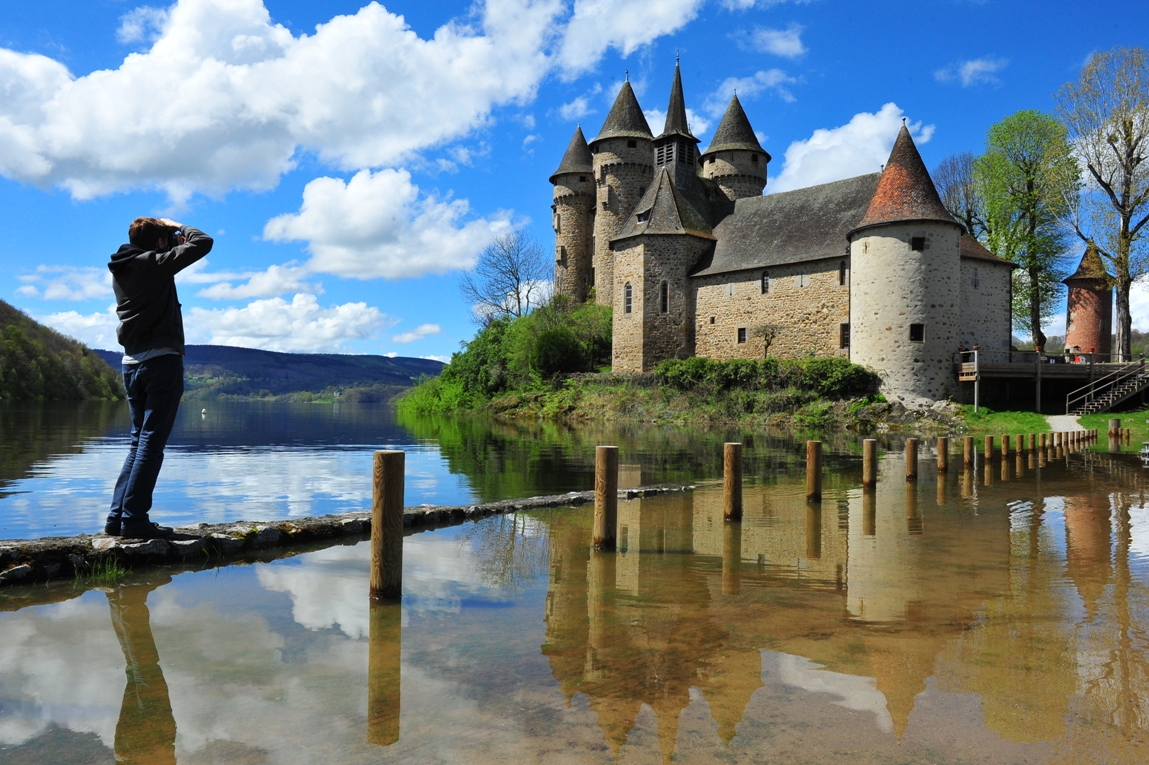
The Castel of Val > History
    Castle Valley through the centuries
    Castle Valley through the centuries
    The name comes from the Latin Val vallis (valley wide). He was given instead of its location on the Dordogne. As evidenced by the presence of two menhirs, now extinct, and as evidenced by several mounds still visible in the vicinity of the Castle, the Val was inhabited by tribes sedentary Neolithic.
    In Gallo-Roman, a wealthy Gauls had a wide field and his residence, which was destroyed by the Alamanni, was later rebuilt nearby.

    This farm had almost the limits of the Lordship of Val.

    Vestiges of that era remain sealed in Ies walls of the Castle: The attentive visitor will see two stone carved in sandstone, encased in the wall of the staircase adjoining the chapel: one represents the sun wheel, the other rays to bend swastikas, a symbol of Gallic god BELENUS highly revered by Arverni.
    At the end of the Gallo-Roman, climate forcing dinsécurité aristocracy to seek refuge in the fortifications, the shale outcrop on which stands the Castle was a natural location ideal for establishing a defensive at that time was limited to a wooden fort surrounded by a fence.

    In the ninth and tenth centuries, the Normans made their appearance and their repeated passages, and the evolution of ordnance, necessitating the building of fortifications.
    Thus, Val was built with lime and sand, a tower, tall square tower closer to the four corners of semi-circular buttresses. The fact remains that the old porch, where the threshold stood at more than 5 m above the ground, which never failed to cause problems to return in haste cattle and horses.
    The dungeon was certainly surrounded from its building of a fence, then closer to a speaker.
    From this forum, the only visible remnant is the thick retaining wall of the great staircase. As to the fence outside the first line of defense, called "trousers", it remains nothing more naturally, but at low water dam, it is possible to see the trail carved into the rock and, at the time was the walkway.
    The Thynières, become owners of Castle Valley around 1150, began in the thirteenth century to improve the fortifications.
    The dungeon, square, rectangular became then he was flanked é six towers two towers were built into the enclosure.
    The gateway to the plaza, enlarged to its present dimensions, was flanked by two new towers in providing protection.

    The walls of XIII'siècle remain, especially nowadays: the side of the octagonal chapel and the wall that joins the corner tower of the last foundations of the tower of bricks around the entrance gate.
    As far as the castle itself, its entry is gone but the presence of the barbican which defended at the foot of the staircase, said it was probably in the round preceding that where the gate current and which has been destroyed.
    As for tours, except two, the lower part remained intact became the foundation of the Castle d'Estaing.
    Their conical shape substantially strengthens the foundations of the castle and allowed the large stone balls dropped slots rebounding strongly on the attackers.
    As designed, the Castle of Val Thynières took into account the best principles of military architectural art of this period.

    Guillot d'Estaing has acquired, in 1440 the Château de Val Guillaume de Thynières in undertook its reconstruction and gave it its current appearance. The builders of the fifteenth century the new castle erected on the foundations of the Castle Thynières. The bases of the conical tower, the base of the curtain parts of the chamber were used. Entry gothic castle, the culmination of the wide staircase, was built and closed by a thick oak door is the one we see today.
    This gate, begins the spiral staircase which leads to the different floors. The windows of the facades northwest and southeast (the least vulnerable) were decorated with mullions by canons of the time. By cons, on the other fronts were decorated openings much smaller, which considered somewhat graceful, were subsequently expanded and embellished. The towers, equipped with battlements, were pierced with loopholes that allowed defenders to use, more and more widespread firearms. They were topped with conical roofs so-called "pepper", flared at the base, bringing an elegant touch to the whole building. A walkway along the curtains, connecting rooms battlements. Finally, the chapel was built, nested in a tower enclosure. All the work of XVII'au XIX'siècle little affect the external appearance of the Castle d'Estaing, nor its indoor facility. It is not the same for the speaker, now virtually disappeared. Only the conservation of the chapel and annexes saved the game that they are adjacent including the old e XIII'siècle tower at the mouth of the dam é access to the island.

    For cons, the beautiful Gothic portal of d'Estaing has virtually disappeared, except the base turrets and walls that will result, reflecting the situation of neglect in which the castle is located at Third XV century. The Fortress of d'Estaing, despite its strength, its location and its design was not entitled to resist the long siege of an army equipped with gear and weapons more effective, for it guaranteed totally against its occupants cons bands of brigands and adventurers who roamed the Auvergne in the fifteenth and sixteenth centuries. The return of order and security that marked the seventeenth and eighteenth centuries led to some disenchantment with these fortresses rur ales which fell, some of them in ruins.
    The Chateau de Val éc snapped this fate and we return in all its majesty, the atmosphere of that time. We must indeed learn to appreciate the beauty and serenity of this landscape from which emerges quellesque are seasonal, romantic atmosphere, a warm southern likely due to the fact that the castle was rebuilt by d'Estaing native of Languedoc, who brought the book to a harmony of proportions that only enhance the picturesque site.

    The lord of the castle until the mid-twelfth century, a period when the Castle became Val, for unknown reasons, the ownership of the house Thynières (who occupied another fort overlooking the Dordogne river, upstream), one almost ignores any of their predecessors but that the lord of Val was always the most important person of Lanobre and he was a promoter of the construction of the village church in the early twelfth century.
    It was they who built the fortress of the thirteenth century and occupied it for almost three centuries. Thynières The family enjoyed a great reputation and many of its members distinguished themselves in the arms and orders. It reached the zenith of his fame in the early fifteenth century when Pierre V, son of William II died (prob ably) at the Battle of Agincourt.

    William of Thynières confronted with serious family problems, had to sell the land in March 1440 and the Chateau de Val Guillaume IV d'Estaing said Guillot.
    Note, however, that the sale does not cover the entirety of the Lord ie Val, but against it included a portion of land bordering Lanobre. What resulted was curious that all the descendants of the buyer and the seller they could claim the title of "Lord of Val and Lanobre in part". La Maison d'Estaing (1 440-l 660) The new owner of Castle belonged to an old family of the Rouergue which counted in its lineage a
    certain Pierre d'Estaing, the latter saved the life of King Philippe Auguste of France at the Battle of Bouvin es in 1214. This feat earned him weapons, and his descendants, the honor, on the crest of the family, Lily of France.
    Guillot d'Estaing then rebuilt the castle, which from 1450 was fully completed and the chapel.

    It then followed generations of d'Estaing who, despite the vicissitudes of history or because of them, were able to keep their families a prosperous and well known, the Castle, its brilliance. Not until the seventeenth century Joachim d'Estaing, knowing some difficulty, had to sell the property of his ancestors. This is not the least of the paradoxes is that even Joachim, who lived at Versailles, had attached all his life, to highlight its origins (which however did not need it) so much so that Boileau, in his 5'satire, took him to Target: "But I can not suffer a fop whose weakness has nothing to build a futile nobility ..," The May 15 1660, Joachim d'Estaing sold the castle and lordship of Val Peter Cousturier.


    The owners of Castle Valley from 1660 to 1948

    1660-1661 Peter Cousturier
    1661-1720 Pierrede Geneste, Marquis's Lair
    1720-1724 Pierre-Gaston lascasas
    The 1724-1747 St. ehamans (Jacques-François d'Hautefort and Jacques-François de Sales)
    1747-1757 Marie-François des Cars
    1757-1779 Val condominium (Louis Charles de Villelume Claude Josephde Naucoze, Jacques Louis Pestel)
    1778-1779 Purchase of 3 parts by Val Ignatius Dubois de Saint-Etienne
    1779-1793 The House of Saint-Etienne
    The Revolutionary Period 1793-1805
    1805-1806 Gaspard de Saint-Etienne
    1806-1813 Master Antoine Offroy Delga
    1813-1814 Gaspard de Saint-Etienne
    1814-1837 André Longueville
    1837-1865 Louis Gauthier
    1865-1883 Jules Souchard
    1883-1898 Charlotte Smith-Souchard
    1898-1948 La Maison d'Arcy


    From 1660 to 1948 From 1660 to 1948, different families succeeded in ownership of the Castle.

    A number of events affected to this period including several restorations that allowed the preservation of the castle: The first restoration of the Castle (1660 - 1685) When he became owner, Peter Cousturier undertook a number of remedies that proved necessary, he remade including the retaining walls of the lower court. Peter Cousturier resold Val August 18th, 1661 at the Marquis Hideout, brave soldier, who had fled to Val between two campaigns, it would therefore make his property a number of improvements. He produced around the castle a French garden (designed, it is believed, by Le Nôtre) which he left as platforms and stairs visible at low water dam.

    He also woods nearby, the park said that the Archers surrounded by walls and prohibited from cutting wood.

    The second restoration (1779-1793) From the early eighteenth century, the Château de Val had become uninhabitable and completely abandoned, it fell almost in ruins. Then it was bought by its three owners Ignatius Dubois SaintEtienne in 1778-1779.
    Originally a market town in the Cantal (SaintEtienne of Chomeil) and nobility recent Ignatius Dubois Sain t-Etienne, holding a vast fortune, acquired many estates in the neighborhood and reconstructed including all of the Lordship of Lanobre and Val.

    In the deed of April 3, 1779, by which M. de Saint-Etienne became the owner, it was found that the Val Castle was in ruins. Prior to moving to Val, the new occupant had to invest 30 000 pounds to restore. The entire roof had to be redone, the large crack in front of the chapel, appeared high in the bottom of the curtain wall of the tower was blocked, the salon was decorated with a large fireplace Louis XVI style, a beautiful parquet floor was laid.
    Castle Valley during the Revolution until the end of 1790, the Revolution had virtually no impact on the life of the manor of Val since December 31, Monsieur de Saint-Etienne was present at the palace, as lord of Val, the new incumbent of the chapel. But the situation became increasingly tense. The lord of Val was arrested and could escape only through the intervention of farmers who held him in esteem. His son Gaspard and Margot has made the
    exile, he saw his property sequestrated in 1793.
    The seals were affixed to the door of the Castle, and Monsieur de Saint-Etienne went to find shelter in a family of friends. During the period of the Executive and despite the seals, the castle was plundered, perhaps even "squatted" by refractory conscription who found there an ideal hideout. When calm was restored, the heirs of M. de Saint-Etienne refused to accept that the succession under benefit of inventory.
    And March 21, 1805, the day of the auction, Gaspard, the eldest son, went purchaser of Castle Valley to the low $ 24 000 francs. The third restoration André Longueville, merchant Bort, having become owner of Castle February 10, 1814, for the monument began a period of slow decay.
    The new owner tried to take maximum advantage of its acquisition, hugging the futaient, selling boards and beams.
    By decision of 1 December 1837, Longueville was expelled from Val: this was in fact a new rescue the castle as if Longueville was retained title, it would have sold the very stones of the towers. Fortunately for the building, Mr. Gauthier bought with his field and devoted his entire fortune to fix it and embellish it.
    He furnished, endowed some stained glass windows, made to decorate the murals from smoking, he also extended surface area, adding to it gradually, neighboring properties. Alas, after more than 25 years Val, financial problems forced Mr. Gauthier for sale.


    And July 21 t 1865, Sir Julius Souchard, Consul of France in Boston, bought at auction the castle and its domain.

    Mr Souchard followed for the restoration work largely undertaken by his predecessor.
    He continued to add to the area of new land, to the point where it became the largest in the region, he opened the current road and planted an avenue of trees. He refurbished the interior: the sa lon was covered with Cordova leather wall and contained a Bacchus attributed to Rubens: a Gothic fireplace was installed, a sumptuous decoration of Renaissance inspiration, with plenty of gold, completing the everything.

    The last owner Mr Souchard died, Val returned to his wife who in 1896 bequeathed by will, the Viscountess d'Arcy, granddaughter of Sir Rouher, Prime Minister of Napoleon III, who had received the nickname of vice-emperor because of his great influence over the Emperor.
    After the death of Mr. and Mrs. D'Arcy, Val returned to their second daughter, Leontine D'Arcy, who married Sir Peter Hénaul t.
    Expropriated by EDF in 1946, Mr. and Mrs. Henault left the castle in 1948.
    They took the beautiful furnishings logically leaving empty rooms. The fourth restaurant.

    From 1949 to today without supervision from the end of 1948, the castle was ransacked by burglars who carried ju squ'aux lead pipes. However, in 1951, the Syndicat d'Initiative de Bort-les-Organs are provided protection by installing the same place a guard and his family.

    In 1953, EDF yielded a nominal fee for the castle to the town of Bort and thanks to the insistence of Sir Maurice George, President of the Syndicat d'Initiative, and Mr. Briggs, regional director of the EDF, who consented, Moreover, to build the national carrier pier present only link with the shore at high water of the reservoir.

    The management was entrusted to the Syndicat d'Initiative, which found itself facing a difficult task both from the expropriation of 1948, the damage had increased.
    An ongoing restoration work was undertaken: the roof of the main building and towers were rebuilt, all the masonry was reviewed, the large entrance tower has been completely restored and the grand staircase and chapel and the first floor was fully stretched tissues to better highlight the Aubusson tapestry, tables and other furniture which were bought slowly, the court was made more attractive and the walkway has been rebuilt The hall "Maurice George", dedicated to rescue Val, has been converted into common, outdoor lighting has been replaced to enhance the night, the Castle on its island.
    Each summer is marked by music concerts and major art exhibitions, an internationally acclaimed, giving Val a movie to live up to its reputation.
    And not to mention the routine maintenance performed every winter by local businesses and which involved the caretaker couple dedication.
    This channel will serve to safeguard the Castle Valley has kept the monument, the recognition of this work is expressed by the flood of tourists who come to discover with amazement.


    Le Château de Val 19110 Bort-les-Orgues Tel : 04 71 40 30 20 E-mail : info@chateau-de-val.com
    Renseignements à l'Office de Tourisme Communautaire du Pays de Bort-Artense :Tél : 05 55 96 02 49 - Fax : 05 55 96 90 79


    Création